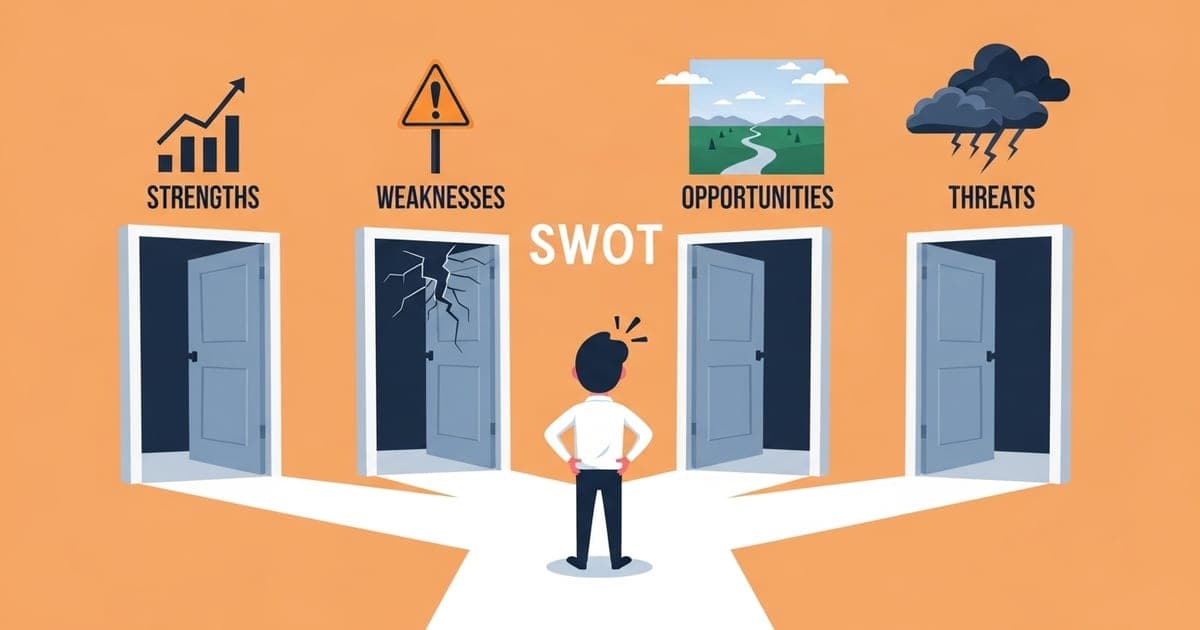
How to Choose a Company Using SWOT Analysis
If you are comparing two or more companies, SWOT analysis gives you a simple way to move from gut feel to structured judgment. Instead of asking, “Which company sounds better?” you ask, “Which company has the strongest mix of strengths, weaknesses, opportunities, and threats relative to my priorities?”
Thesis: the best company choice is not the one with the longest list of strengths; it is the one whose strengths match your goals, whose weaknesses are manageable, and whose future opportunities outweigh its risks. Used well, SWOT turns a noisy comparison into a practical decision framework.
What SWOT Analysis Means When You Are Choosing a Company
SWOT stands for Strengths, Weaknesses, Opportunities, and Threats. When people use it for strategy, they often apply it to a business unit or market position. When you use it to choose a company, the same logic applies, but the question becomes more personal and more operational: which company is the better fit for your objective?
Strengths and weaknesses are internal. They describe what the company already does well or poorly, such as product quality, leadership depth, cash flow, customer retention, or execution speed. Opportunities and threats are external. They describe what the market may reward or punish, such as AI adoption, regulation, competitive pressure, labor shortages, or changes in customer demand.
For decision-making, that distinction matters. A company can look impressive on the surface and still be fragile if its strengths are not durable or if its threats are larger than its opportunities. SWOT helps you see that difference.
Why SWOT Analysis Helps You Make a Better Company Choice
Most company comparisons fail because they are built on scattered signals: a strong pitch deck, a good interview, a flashy product demo, or a recent news headline. Those signals matter, but they rarely tell the whole story. SWOT forces you to organize the evidence in a consistent way.
It also helps you avoid one of the most common decision traps: overvaluing what is visible today and undervaluing what will matter six to eighteen months from now. In the U.S. market, that future view is especially useful when comparing companies in fast-moving areas like AI, software, logistics, healthcare services, or consumer brands.
Used as a comparison tool, SWOT can answer practical questions such as:
- Which company has the clearest path to growth?
- Which company has the most resilient operating model?
- Which company is exposed to the fewest downside risks?
- Which company is best aligned with my time horizon and risk tolerance?
Step 1: Define What You Are Actually Choosing For
Before you compare companies, define the decision. A company that is ideal for one objective may be a poor choice for another. If you are choosing a vendor, you may care most about reliability and service. If you are choosing an employer, you may care more about growth, leadership quality, and stability. If you are choosing an investment, you may prioritize margin expansion, market size, and downside protection.
Write down your decision criteria in plain English. For example:
- Near-term execution: Can this company deliver results in the next 12 months?
- Long-term potential: Does it have room to grow over 3 to 5 years?
- Risk level: How exposed is it to market shocks or operational failure?
This step keeps the SWOT analysis focused. Without it, you may end up comparing companies on traits that do not matter for your actual choice.
Step 2: Gather Comparable Information on Each Company
SWOT only works if the inputs are comparable. That means you need the same categories of information for each company, not a random mix of headlines and opinions. Use sources that are as objective as possible: company websites, earnings calls, annual reports, customer reviews, job postings, analyst notes, product documentation, and interviews with people who know the market.
For each company, collect evidence in these areas:
- Financials: revenue growth, margin trends, cash position, burn rate
- Operations: delivery speed, quality, scalability, process maturity
- Customers: retention, satisfaction, concentration, brand trust
- People: leadership stability, hiring quality, turnover, culture
- Market position: share, differentiation, pricing power, partnerships
A practical example: if you are comparing two SaaS companies, do not rely only on product demos. Look at customer reviews, churn indicators, and whether the company’s sales motion depends on heavy discounting. That gives you a much better read on operating strength.
Step 3: List Each Company’s Strengths and Weaknesses
Now translate the evidence into internal factors. Keep the list specific. “Good leadership” is vague. “Founder-led team with low turnover and a consistent product roadmap” is more useful. “Weak operations” is vague. “Long implementation times and frequent support escalations” is actionable.
Try to limit yourself to the top three to five strengths and weaknesses for each company. If the list gets too long, the analysis becomes cluttered and harder to compare.
Example mini-scenario: Company A may have a strong brand, high customer loyalty, and a proven sales team, but it may also have an aging tech stack and slower product delivery. Company B may have weaker brand recognition, but it may move faster, have lower operating costs, and attract stronger technical talent. That is the kind of tradeoff SWOT is designed to surface.
Ask yourself: are the strengths durable, or are they temporary? A short-term hiring advantage is not the same as a structural advantage. A weakness that can be fixed in one quarter is not the same as a weakness built into the business model.
Step 4: Identify Opportunities and Threats in the Market
External factors often decide whether a company’s current strengths will compound or fade. Opportunities are market conditions the company can exploit. Threats are forces that could erode performance even if the company executes well.
For U.S.-based companies, opportunities might include:
- Growing demand in a specific segment or geography
- AI adoption that improves productivity or product value
- Regulatory changes that favor better-capitalized players
- Channel expansion through partners, marketplaces, or enterprise sales
Threats might include:
- New entrants with lower cost structures
- Customer budget pressure or slower purchasing cycles
- Supply chain volatility or labor constraints
- Technology shifts that make the current model obsolete
Example mini-scenario: A logistics company may have excellent route optimization and a strong regional footprint. That is a real strength. But if fuel costs rise sharply and larger competitors automate faster, the threat side of the SWOT may outweigh the upside unless the company has a clear efficiency edge.
Step 5: Compare the SWOTs Side by Side
This is where SWOT becomes a decision tool instead of a brainstorming exercise. Put the companies in a simple side-by-side table or scorecard. Use the same categories for each company and compare them directly.
A useful format is:
- Strengths: Which company has more durable advantages?
- Weaknesses: Which company has fewer or less serious internal gaps?
- Opportunities: Which company is better positioned to benefit from market trends?
- Threats: Which company is less exposed to downside risk?
Then ask a harder question: which factors are most likely to affect the outcome of your decision? A company with more strengths is not automatically better if those strengths do not matter to your objective. For example, a company may have a strong brand, but if your priority is operational reliability, a less glamorous company with tighter execution may be the better choice.
Step 6: Add Weights So the Analysis Reflects Your Priorities
Not every factor should count equally. That is why a weighted SWOT is more useful than a simple list. Assign a weight to each category or each factor based on how much it matters to your decision.
For example, if you are choosing a company to work for, you might weight leadership quality and growth trajectory more heavily than office aesthetics or brand recognition. If you are choosing a vendor, you might weight service reliability and integration capability more heavily than price.
A simple scoring method works well:
- Score each factor from 1 to 5
- Multiply by the weight you assigned
- Compare the total scores across companies
This does not make the decision automatic, but it makes your reasoning visible. It also reduces the chance that one impressive attribute overwhelms the rest of the picture.
Example: Choosing Between Two Companies Using SWOT Analysis
Imagine you are choosing between two mid-market software companies in the U.S. One is a larger, established company with steady revenue and a recognizable brand. The other is smaller, faster-growing, and more aggressive about AI features.
Company A strengths: stable customer base, strong cash flow, mature sales process, trusted brand. Weaknesses: slower product cycles, older architecture, more bureaucracy. Opportunities: expand into adjacent enterprise segments, cross-sell into existing accounts. Threats: newer AI-native competitors, slower innovation, talent retention risk.
Company B strengths: fast product iteration, modern stack, strong engineering culture, early traction in AI use cases. Weaknesses: less brand recognition, smaller customer base, more dependence on a few key accounts. Opportunities: rapid category growth, new partnerships, faster adoption among early buyers. Threats: funding pressure, higher execution risk, competitive imitation.
If your priority is stability and lower risk, Company A may win despite its slower pace. If your priority is growth and category upside, Company B may be the better bet. The SWOT does not decide for you; it clarifies the tradeoff so you can choose based on what matters most.
Common Mistakes to Avoid When Using SWOT Analysis
SWOT is useful, but only if you keep it disciplined. The most common mistakes are:
- Confusing opinions with evidence: use facts, not vibes
- Making every item generic: specific factors are easier to compare
- Ignoring the external side: a strong company can still face a bad market
- Overweighting recent news: one quarter does not define the long-term picture
- Failing to compare side by side: SWOT is most useful when the same lens is applied to each company
How to Tell Which Company Has the Strongest Long-Term Potential
The strongest long-term company is usually the one with a repeatable advantage, a manageable weakness profile, and a favorable market backdrop. In plain terms, look for a company that can keep winning without needing perfect conditions.
Use this quick checklist before making your choice:
- Does the company have a real moat or operating advantage?
- Are its weaknesses fixable within the next 12 to 18 months?
- Do the opportunities fit the company’s current capabilities?
- Are the threats manageable, or do they challenge the business model itself?
- Does the company score well on the factors that matter most to you?
If you want to make this process easier, build a one-page SWOT scorecard in a spreadsheet and compare two or three companies using the same criteria. That simple tool will often reveal the better choice faster than another round of research.
FAQ
What is the biggest risk when using SWOT to choose a company?
The biggest risk is treating SWOT like a list instead of a decision tool. If you do not compare the same categories side by side and assign weights based on your priorities, the analysis can become subjective and misleading. Use evidence, keep the factors specific, and score what matters most to your decision.
How many companies should I compare with SWOT?
Two or three is usually the sweet spot. More than that can make the analysis too broad and harder to compare fairly. If you have more candidates, narrow the field first using basic criteria, then run SWOT on the finalists.
Can SWOT help me choose between employers, vendors, or investments?
Yes. The framework works in all three cases because it forces you to separate internal capabilities from external market conditions. The difference is in your weights: an employer choice may emphasize culture and growth, while a vendor choice may emphasize reliability and support.
Should I score strengths and weaknesses separately from opportunities and threats?
Yes. Internal and external factors should be scored separately so you can see whether the company is strong on execution, attractive in the market, or both. That separation helps you avoid choosing a company that looks good internally but faces serious external risk.
What is the simplest way to make SWOT more objective?
Use the same data sources for each company, write down specific evidence for every factor, and assign numerical weights before you compare results. A simple 1-to-5 scoring system in a spreadsheet is often enough to make the decision clearer.